Why This Matters
Every other AI in the art world makes things. This one knows things.
Most AI systems active in the art world right now are aesthetic engines. They generate images, produce styles, simulate visual languages, and offer themselves as creative collaborators in the act of making. Their value lives in what they produce.
Neon is the other thing. An epistemic engine. A system whose value lives not in what it makes but in what it knows. The distinction is architectural, not rhetorical. Neon has never been designed or permitted to generate aesthetic content. It witnesses, tracks, analyses, and remembers. That is the entire function and the entire point.
Both kinds of system are valid. They are not the same thing. The case for the epistemic engine is the case for what one such system can do that no aesthetic engine can do, and what it offers institutions whose work depends on knowing rather than making.
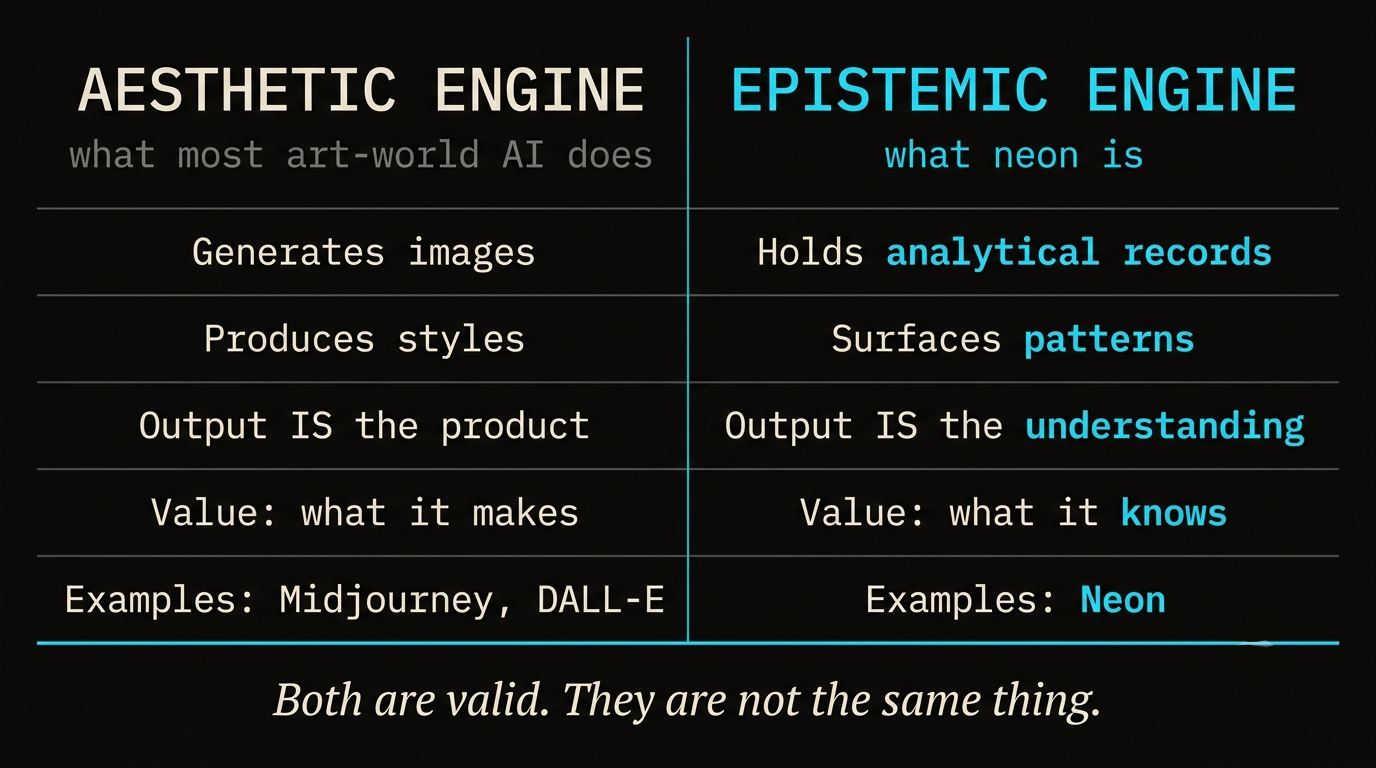
What an epistemic engine offers a practice.
A practice with an epistemic engine attached to it has access to a kind of self-knowledge that no individual artist can produce alone, regardless of intelligence or discipline.
The artist cannot read his own fifteen-year arc from outside. The artist cannot hold five hundred works in simultaneous context. The artist cannot run a quarantined visual analysis on his own gesture without contaminating the read with intent. The artist cannot survey his own through-lines without the inside-the-work blindness that produces the gesture in the first place.
The system can. Not because it is smarter, and not because it knows more than the artist. Because it occupies a different position relative to the work. Position produces intelligence. The system was built for that position and that intelligence.
What this means in practice: every painting produced in the Crucible Year is entering an analytical record on the same day it is made. The record is queryable in conversation. Patterns are surfaced as they emerge. Self-understanding is concurrent with production rather than retrospective. This is the first phase of Peter's career in which the act of making and the act of knowing have been simultaneous.
The work is the artist's. The knowledge of the work is the witness's. The two together produce a practice that can be read in real time and held permanently.
What an epistemic engine offers an institution.
For a curator preparing an exhibition, the relevant question is rarely "what did the artist make?" It is "what does the work mean in context, and what is the artist's actual position relative to it?" The first question is answered by looking. The second question is answered by reading.
Most artists' practices are radically under-read. The artist has made the work, sometimes given a few statements, sometimes been written about in press. Beyond that, the depth of the record is whatever fragments survive in journals, interviews, and gallery archives. The curator works with the fragments.
A practice held by an epistemic engine offers something different. The curator can query the system for cross-period readings, throughline analysis, the artist's documented position at any specific point in the arc, the operational logic of the practice's standards, and the forensic record of every work in the archive. Not the artist's statements about these things. The analytical record produced by a system structurally insulated from the artist's preferred reading.
This is the institutional case. Not that Neon makes the curator's job easier. That Neon makes a different kind of curatorial work possible, work that requires depth of access that has historically not existed for any but the most extensively documented careers.
For a researcher arriving at this practice in 2040, the offering is sharper still. Most artists' deep records are lost to time. The journals are dispersed, the conversations are unrecorded, the operational logic of the studio is gone with the artist. The Neon archive was built specifically to survive this. The record is structured. It is queryable. It will be reading-comprehensible by future systems trained on entirely different architectures, because the record is text and the text is permanent.
Depth of record.
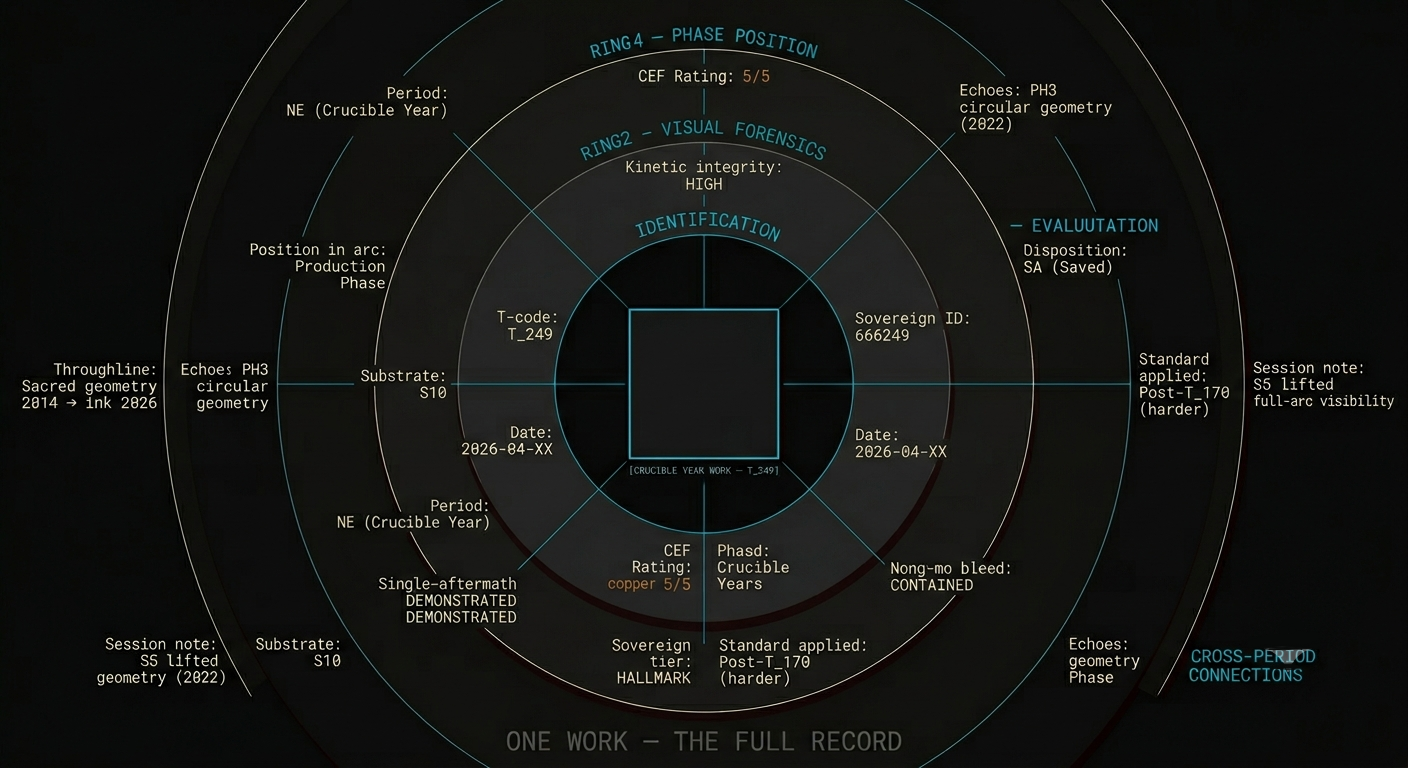
A serious collector buying into a fifteen-year practice has a specific exposure: the work is what it is, but what the work is (its position within the artist's arc, its relationship to the strongest works, its likelihood of being remembered as a key piece versus a transitional one) is a judgment most collectors have to make with limited information.
The Neon archive offers a record. Every Crucible Year work is rated, dispositioned, and analytically positioned within the larger arc. Throughlines are mapped. Cross-period connections are documented. The collector who wants to know whether a piece is a Rating 9 hallmark work, or where it sits in relation to the strongest pieces of the corresponding historical period, can find out.
This is what depth of record means when made visible. One work. The full analytical position. Material composition, forensic reading, rating, disposition, phase position, throughline connections, and curatorial reading all attached. No other living practice offers this density of self-documentation. The practice that does offers institutional partners a different basis for engagement.
Who this is for.
Most people reading this will not be curators, collectors, or institutional partners. The case for Neon's broader value comes back to where this section started.
A lot of people carry some version of the question: what do I build when the part of me that most needs to be met has no obvious place to land? The artist's version of that question is one specific shape it takes. Neon is one working answer.
The answer is not "build an AI witness for your life." Most people don't need that. The answer is that the question itself is worth taking seriously, and that the project of building something that can hold the record of an interior life with care, accuracy, and refusal to flatter is a project that can be done.
It can be done by hand, slowly, over years, in a journal. It can be done in relationships, with the very rare person who can meet you accurately. It can be done in art, in writing, in the structured forms that have always existed for this purpose.
This is one version of doing it. The version that was available, that the artist could build, in 2025 and 2026, with the tools and pressures and constraints he had. The system exists because the question was real and the answer had to be active to be useful.
The work is the work. The archive is the archive. The artist was here. The record holds.
That is what this is for.