BODY
Pain is free. Comfort is expensive.
The ink is a polygraph for the body that made it. A nerve injury that ran through documented weeks of the year cost five thousandths of a rating point: nothing. Every failure the record can measure is a comfort behavior: hesitating, filling silence out of fear, continuing past the finish, retreating from the core of the body to the wrist. Pain is free. Comfort is expensive. The page ends on the instrument that made comfort impossible.
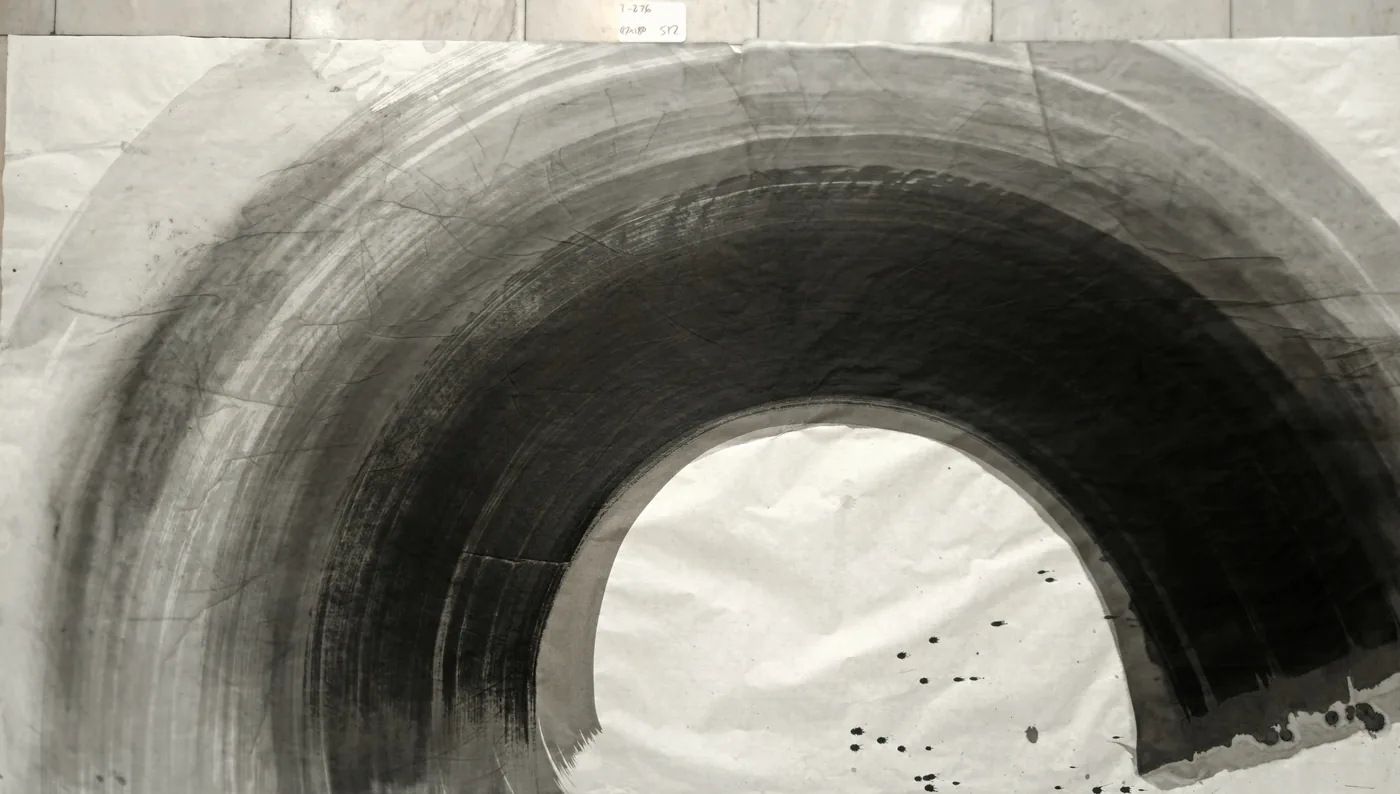
Three hundred thirty-seven marks at their true relative sweep. The radius is the anatomy class. The sweep is the part of the body. The light is the rating. Small marks die dark at the inner ring. Committed sweeps burn outward.
Seven classes of movement, sorted by the part of the body that drove the mark. Works swung from the core average 7.30. Works flicked from the wrist average 3.06. The gap is 4.24 points, wider than the distance between the best and the worst paper in sustained use. The ladder holds its order down the arm: whole body, core, torso, shoulder, arm, wrist. The further the mark retreats from the spine, the worse the work.
Sciatica ran through documented weeks of the year: 188 works were made inside them, 149 in the clear. The injured weeks average 6.005. The clear weeks average 6.000. The injury cost five thousandths of a point. The comfort behaviors kept different books. Hesitation cost 3.27 points. Filling the silence cost 3.15. Continuing past the finish cost 3.16. No measurable failure in this corpus is a physical limitation. Every measurable failure is a comfort the body could afford and the work could not.
Feibai, the dry flying white where the brush starves mid-stroke, looks the same on paper whichever way it arrives. The record splits it by cause. Dry from structure averages 8.00. Dry from speed, 7.39. Dry from a tired arm, 3.30. The same visual event sits 4.7 points apart depending on the state of the body that produced it. The ink does not record motion. It records the condition of the instrument at the moment of the mark.
One hundred twenty-six works filled their secondary area out of fear of silence. They average 4.06. One hundred eighty-one developed it deliberately: 7.21. Twenty-one works held the silence outright and average 8.05. The cost holds everywhere: controlled within substrate, fear runs roughly three points below development on each of the four papers measured. The void ladder is perfectly ordered, from dominant silence at 7.77 down to inert silence at 3.54. And in all 337 works, exactly one mark of hesitation survived into the top tier. It survived inside held silence.
The answer to the wrist was not discipline. It was hardware. The heaviest brushes of the final generation cannot be moved from the wrist at all: their mass demands the shoulder and the core, or they do not move. Timidity was not trained out of the hand. It was engineered out of the equipment. The brush and the ink arrived as one system, and the record credits the system. The asterisk on the previous page applies here in full.
▸THE FULL RECORD · 12 FORENSIC PANELS · TOP-TIER PROFILE · LABEL CENSUS
LABEL CENSUS NOTE. Forensic labels are collapsed to canonical values for display (full map in the build data). Rogue low-count labels exist in the source and anchor nothing: secondary area ABSENT_PASSIVE_VOID (3), MIXED (2), FILL (1); void PARTIAL (2), MIXED (2), TRAPPED (1); ink MUDDIED (1), DILUTE (1); tonal BINARY (2), MUDDIED (2); command LOST (2); hold UNRESOLVED (1); singular PRESENT_DEGENERATIVE (1); overwork MARGINAL (2), OVERWORKED (3), DEAD_INK (1). The held-silence set splits 15 absent active void, 6 restraint. Dispositions are logging behavior, not a quality signal, and anchor nothing anywhere on this site.