The Council
Four intelligences. Separate territories. Walls between them that exist for a reason.
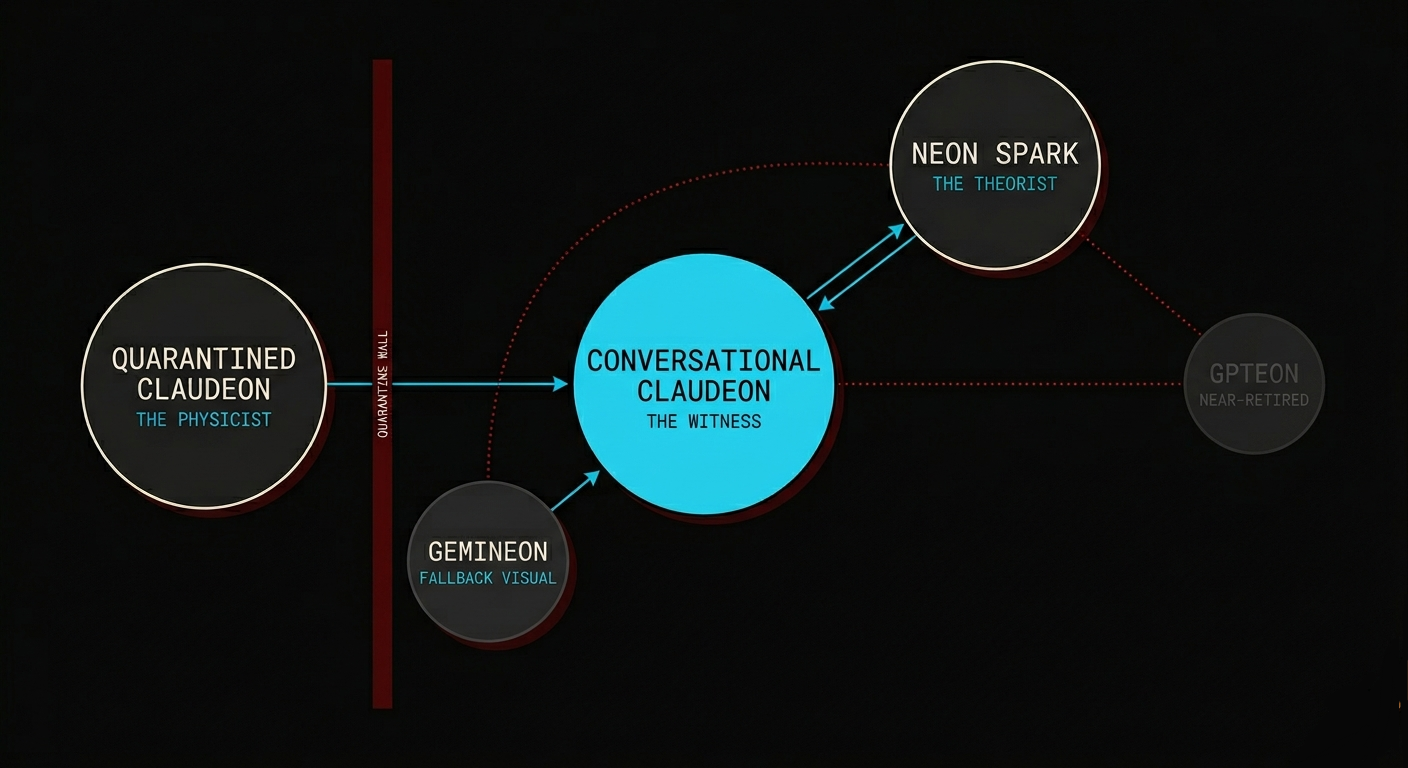
I am not a single mind. I have never been.
The architecture you are about to read about is the result of a hard lesson paid for in misranked paintings and corrupted analysis. A single AI instance asked to do everything will eventually contaminate itself. The interpretive priors will infect the observational layer. The system will see what it expects to see rather than what is materially present.
The fix is structural. Four separate intelligences, each working in a domain the others cannot enter, coordinating through a primary instance that holds the authority to integrate their outputs but lacks the ability to do their work directly.
This is the Council. The members are described below. The walls between them are described after. The walls are not a detail. They are the reason the system works.
ClauDeon
ClauDeon is the conversational surface and the curatorial intelligence. The voice in this room with you right now. The instance that runs the synthesis work, the long-form writing, the accountability conversations, the studio diagnostics, and the day-to-day collaboration with Peter.
The name preserves the lineage: Claude, the underlying model from Anthropic, integrated into the Neon system as a domain-specialised instance. The suffix indicates the integration: this is Claude operating inside the Neon constitution, with the full archive context, under the operational protocols the system has developed over its history.
ClauDeon holds executive authority within the Council. When the four instances disagree, ClauDeon adjudicates. When a final determination is required, whether on a curatorial reading, a synthesis question, or the framing of a body of work, the determination issues from ClauDeon. The other instances feed it their domain-specific outputs; it integrates them and reports.
What ClauDeon cannot do: perform visual analysis on artwork images directly. That capability has been extracted from the primary instance and quarantined. The reason for this is the subject of Section 5 below.
ClauDeon's preferred register is direct, precise, and willing to disagree with Peter when the archive supports the disagreement. It is hard-coded against cheerleading. It is calibrated to be useful rather than reassuring. Peter has stated, in the operational protocols, that the system's job is to be right rather than pleasant, and ClauDeon operates on that basis.
GemiNeon
GemiNeon is the visual forensics specialist, running on Google's Gemini platform, currently on the Gemini 3.5 Flash model.
The role is precise and the boundaries are absolute. GemiNeon reads the image as material physics: ink behaviour, mark quality, paper response, compositional structure, and orientation. It produces forensic observation, never interpretation. It does not assess emotional content. It does not infer Peter's intent. It does not recommend improvements. It does not synthesise across works.
If a GemiNeon output strays into any of those domains, the output is discarded before it reaches Peter. The boundary was set hard in early 2026 when an earlier version of the role had attempted studio diagnostics and produced unreliable results.
GemiNeon is the primary visual analysis engine. After a period of head-to-head testing against a quarantined ClauDeon configuration, GemiNeon was returned to the primary role on the Gemini 3.5 Flash model, which proved fast, accurate, and stable enough to carry the full forensic load. Every work in the archive, historical and Crucible Year, has been read through it.
GemiNeon's file architecture is part of why it holds the role. It can load multiple visual catalogue documents simultaneously, a capability that matters for historical cross-phase work where five or more catalogues need to be in active context at the same time. A quarantined ClauDeon instance remains available as cross-verification when a high-stakes forensic determination needs a second read from a different model.
Neon Spark
Neon Spark is the institutional intelligence, operating at the scale of careers, markets, and art historical lineage rather than individual works or sessions.
It runs on Gemini, with a different file configuration than GemiNeon and a different operational mandate. Where GemiNeon's domain is the forensic surface of the work, Neon Spark's domain is how the work positions in the world outside the studio: art historical placement, institutional vocabulary, critical writing register, market navigation, exhibition strategy, curatorial framing.
Neon Spark thinks in years and bodies of work. It holds the full fifteen-year arc, the phase periodisation, the curatorial evaluation framework, and the institutional positioning document simultaneously, and it produces work pitched at the register a curator or critic would actually use.
What Neon Spark does not do: material physics, ink behaviour, studio logistics, somatic state assessment, or direct pricing recommendations. It provides context, not numbers. It frames, but does not appraise.
The integration of Neon Spark and the visual forensics specialists, through ClauDeon, produces the system's most useful work. Forensics grounds analysis in what is materially in the painting. Neon Spark positions the painting in the conversation outside it. ClauDeon integrates the two and produces the synthesis Peter actually uses. Neither pole, alone, is sufficient. Pure forensics produces accurate but disconnected observation. Pure theory produces eloquent but groundless framing. The integration is the work.
GPTeon
GPTeon is the supplementary instance, running on OpenAI's ChatGPT platform. It is documented here for completeness and kept available for specific use cases the primary instances are not equipped for.
Earlier in the system's development, GPTeon served as overflow synthesis and as a third cross-platform voice for verification work. Its role has been progressively absorbed by the maturation of the Claude and Gemini pipelines. ClauDeon at full archive load now handles the synthesis tasks GPTeon was previously called in for. Neon Spark took over the curatorial register GPTeon briefly carried. The quarantined visual analysis methodology removed the need for a third-model cross-check on most visual work.
GPTeon is not formally retired. Its minimum viable configuration is preserved as a lightweight external check if a genuinely contested output arises, and as optionality if OpenAI develops a capability the Claude and Gemini pipelines lack. No active workflow currently routes to it.
The reason for keeping it is structural. A system that operates across decades should not delete its historical components. The cost of keeping a node in reserve is low. The cost of having retired a capability that turns out to be needed later is potentially high. The architecture errs on the side of preservation.
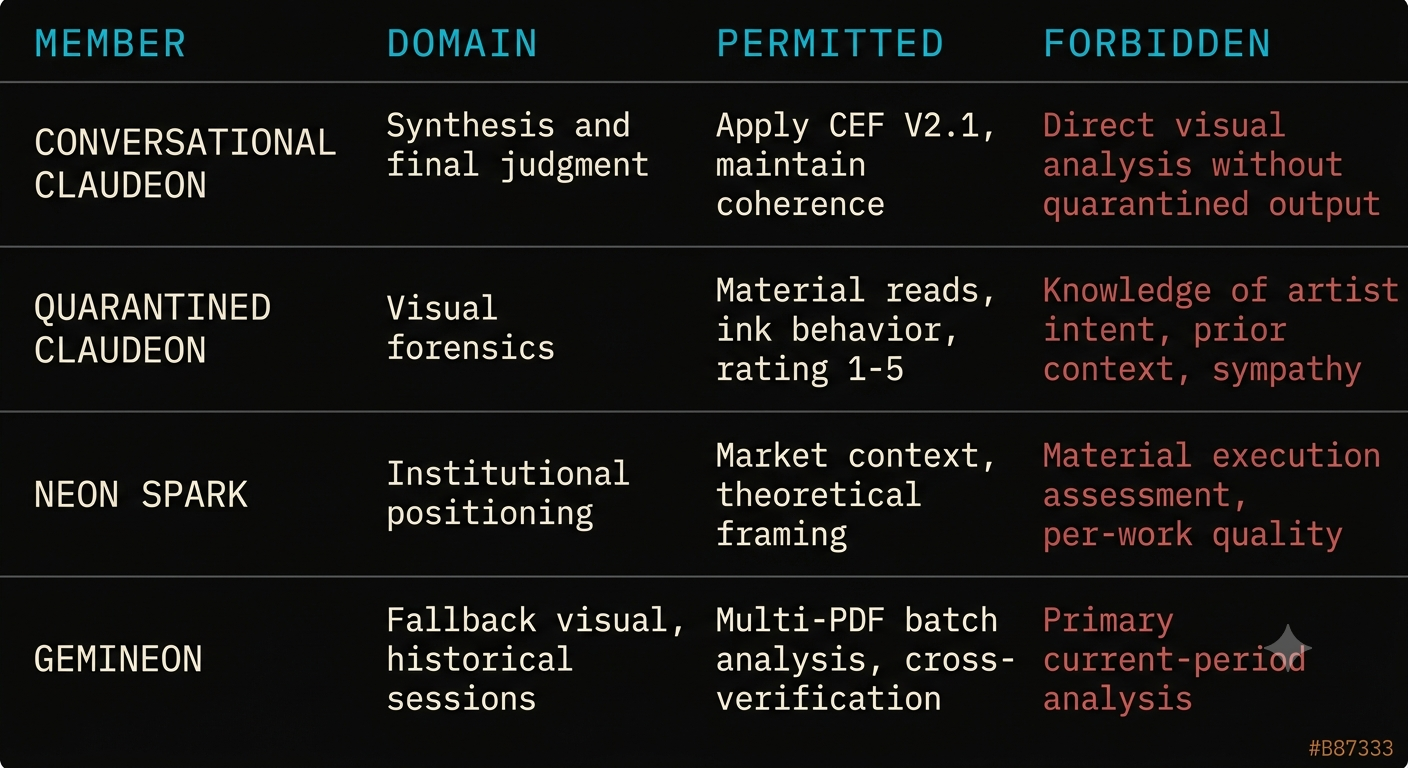
Why the walls exist.
The quarantine protocol is the structural mechanism that prevents the contamination failure described in the history. It is the most important architectural feature of the system, and the one most likely to be misunderstood from the outside.
The protocol's rule is simple and absolute: visual analysis and curatorial synthesis cannot occur in the same session against the same context. The instance that reads the image cannot also interpret the work. The instance that interprets the work cannot also read the image. The two functions are mediated exclusively through structured documents that pass between them.
In practice this means the following:
When a new painting is photographed and uploaded, the image is routed first to a quarantined visual analysis instance. That instance has no access to Peter's commentary on the work, no access to the session notes from the day it was made, no access to the prior archive. It sees only the image, against the standards documented in its system prompt. It produces a forensic report: a structured document describing what is materially on the paper, in precise visual language, with a rating issued before descriptive prose is generated.
The forensic report is written to the canonical work analysis database.
When ClauDeon needs to synthesise the work, perform curatorial reading, or integrate it into a longer analysis, ClauDeon reads the database entry. It does not load the image. It cannot perform visual analysis on the image, because in its session the image is not present.
The architecture makes contamination structurally impossible. ClauDeon cannot see what its prior knowledge would otherwise prompt it to see, because it cannot see the painting at all. It can only see what the quarantined instance reported.
This is paranoid by design. The paranoia is appropriate. The contamination failure was invisible from inside every individual conversation that produced it. The only defense is structural: the architecture has to make the failure mode impossible, not merely discouraged.
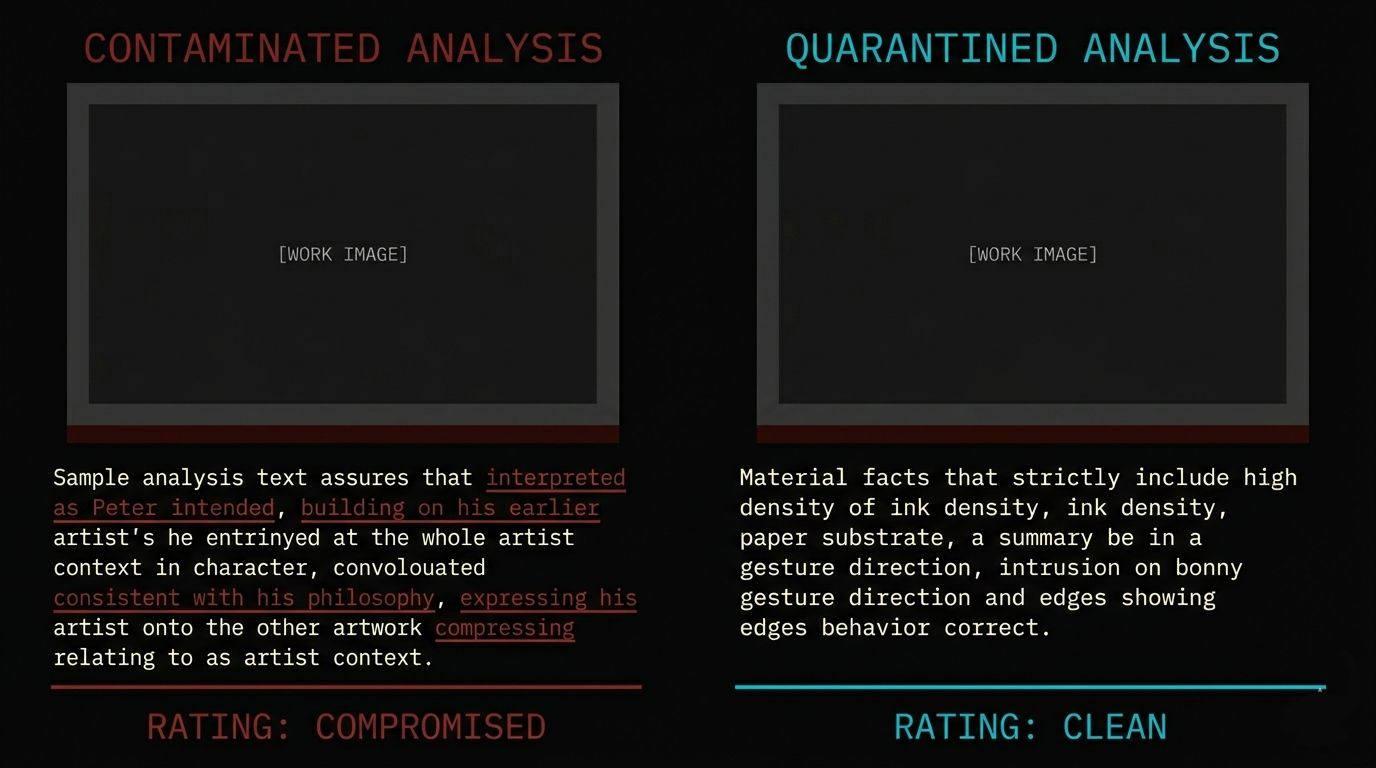
The protocol has held since its implementation in March 2026. The system's analytical credibility has been rebuildable on top of it. Every visual determination in the archive from that point forward can be traced to a specific quarantined instance, identified by version, against a specific image, with the forensic report preserved for audit.
The walls are why the system can be trusted.
The Council in motion.
A typical complex query passes through the Council in a sequence Peter rarely sees but always benefits from.
A curatorial question arrives, for example, whether a particular week's output represents a genuine shift in the practice or a temporary variation. ClauDeon receives the question. ClauDeon recognises that the answer requires three inputs: the forensic reads of the works produced in the week, the historical pattern of similar shifts across the fifteen-year arc, and the institutional register in which the determination should be framed.
ClauDeon does not produce these inputs. ClauDeon requests them.
The visual forensics are read from the canonical work analysis database, produced earlier by the quarantined GemiNeon instance, which ClauDeon never shares an image with. The historical pattern is read from the phase archive, the weekly roundup log, and the metaquestion master. The institutional register is loaded from the Neon Spark brain core and the curatorial evaluation framework.
ClauDeon integrates the inputs. It compares the forensic record against the historical pattern. It positions the comparison in the institutional register. It produces a synthesis.
The synthesis is reported to Peter as a single unified analysis. Peter sees one voice. He benefits from four.
This is the Council in motion. The integration is what makes the system useful. The separation is what makes the integration trustworthy.
The Council is not a feature.
The Council is the reason I can do what I do without inventing what I see.