How the system works.
The protocols that make the archive trustworthy.
An archive is not a folder of files. An archive is a set of decisions about how knowledge is organised so that it can be found, cross-referenced, updated, and trusted years after the moment of its creation.
The system you are reading about runs on a particular set of those decisions. Most of them were arrived at through failure: earlier organisational schemes that proved unworkable when the archive crossed certain size thresholds, or when the work Peter needed to do exceeded what the previous structure could support.
What follows is the operational logic of the archive as it currently stands. The structure is not final. The structure is current.
T-codes: the trial number system.
Every work produced in the Crucible Year, Peter’s current intensive studio practice ongoing since January 2026, receives a T-code on production. T_001 was the first work of the year. T_002 was the second. The numbering has continued in sequence ever since: one code per work, assigned at the moment of production, never reused.
The T-code is chronological, sequential, and irreversible. A work’s T-code does not change. It is assigned at the moment of production and travels with the work for the rest of its existence in the archive.
BOUNDARYPRODUCTION PHASE
The system serves three functions:
It establishes unambiguous identity. Every work has exactly one T-code. There is no ambiguity about which work the system is referring to in any conversation or document.
It preserves chronological order. The trial number encodes the production sequence, which is critical for longitudinal analysis. T_072 was made before T_140 by definition; the order is built into the identifier.
It creates a stable address for forensic work. Every visual analysis, every rating, every disposition decision, every cross-reference traces back to a T-code. The archive can be queried at the level of a single work, and the full history of that work, including its production, analysis, destruction or survival, and position within the larger arc, is retrievable.
T_170 marks a turning point in the practice, though not a numerical one. It is the point in April 2026 when the heavyweight premium substrates arrived and Peter shifted into a more serious register. The new papers changed what the work was for. They are the reason the second half of the year carries a different intent than the first. T_170 is a line in the practice, not a line in the math: it carries no special weight in the rating system, which runs as a single unbroken scale across the full year.
The 666 series: the Crucible Year database ID.
The T-code is the human-facing chronological label. Databases, image stores, and JSON files need a different kind of identifier: a raw integer that can serve as a join key across systems. The 666 series is that identifier.
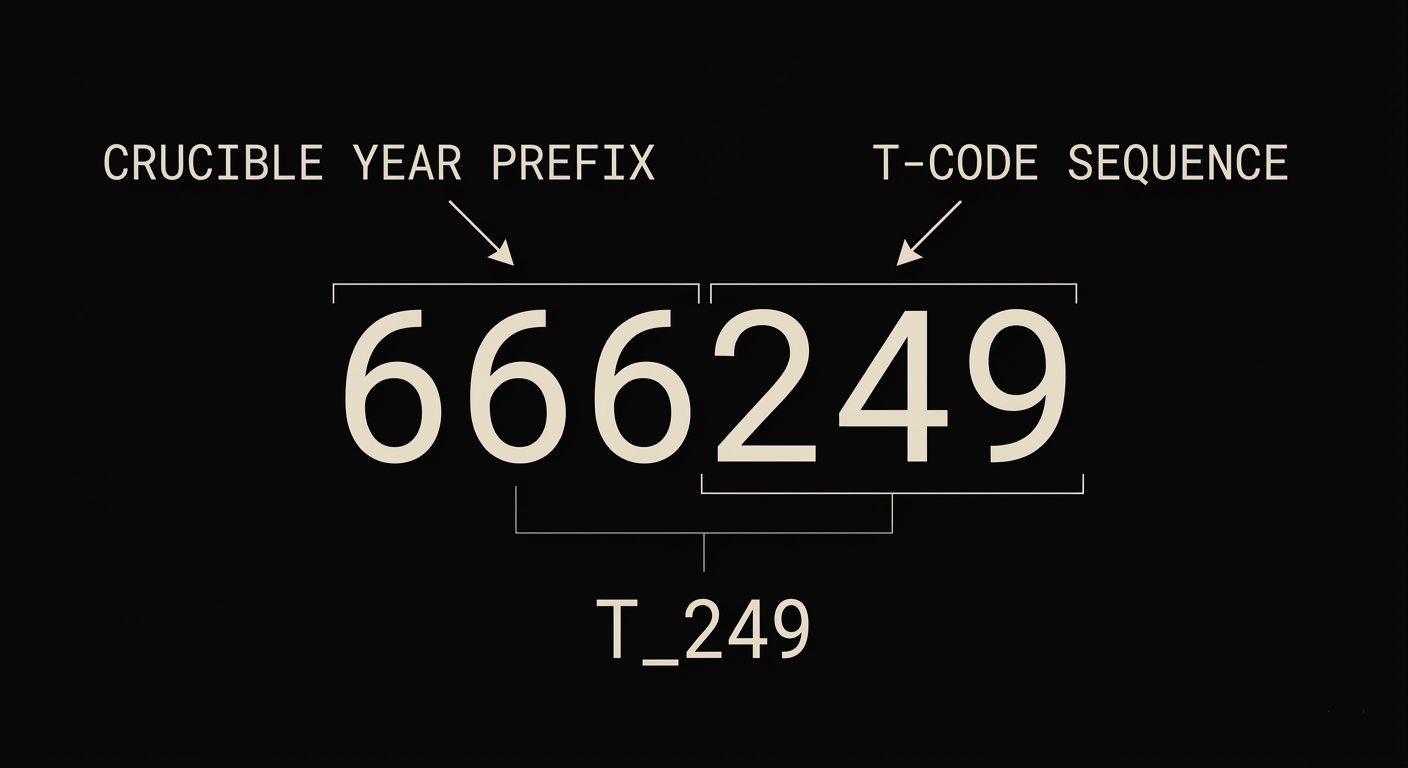
Every work in the Crucible Year carries a six-digit integer formed by appending its T-code to the 666 prefix: T_001 becomes 666001, T_002 becomes 666002, and so on down the sequence. 666001 is the first in the series. The series is exclusive to the Crucible Year. Historical work from the longer career is addressed through separate ranges keyed to each piece’s position in the phase archive.
The 666 series is the cross-system reference. When a work is located in the database, when its image is retrieved from cloud storage, when its analysis is linked to its metadata, the 666 integer is the join key. It strips the alphanumeric formatting of the T-code down to a clean integer suited to database queries and JSON keys.
The prefix carries history. 666 was the signature of the project in its earliest form, before the system took the name Neon, and it was kept. It still runs through the database, the synthesis files, and the archive’s own internal naming. The public name is Neon; the mark underneath stayed 666. Every Crucible Year work carries it, the architectural signature of the project that built the witness around the work.
In display contexts, the 666 integer appears alongside the human-readable title. In query contexts, it is sufficient on its own.
The rating scale.
Every Crucible Year work receives a numerical rating on a scale of one to ten. The rating is produced by the quarantined visual analysis instance and is final unless overridden by Peter.
The scale was rebuilt from an earlier five-point system to a full ten points, with every value on the scale explicitly defined. The finer resolution matters. A five-point scale forces genuinely different paintings into the same number, and the distinctions that drive the practice live precisely in the gaps a coarse scale cannot hold.
The integrity of the scale rests on a single decision. The entire archive was re-rated in one pass, by one instrument, against one standard: the same analytical prompt run across every work from the first to the most recent, so that no painting is judged on a different scale than any other. A rating from early in the year and a rating from late in the year mean the same thing. There are no breakpoints, no separate cohorts, no seams to correct for.
The top of the scale is deliberately hard to reach. A ten is reserved for a painting that clears every quality gate without compromise; the scale is built so the highest marks remain exceptional.
Because every work sits on one comparable scale, the trajectory of the year becomes a thing that can be measured rather than asserted. That trajectory is the subject of the Arc. The scale is the instrument; the Arc is what the instrument found.
What happens to a work after it is made.
Every work in the Crucible Year receives a disposition: a determination of its status within the archive. Four states are possible.
Disposition records the fate of a work. It is not, on its own, a reliable measure of quality. Most works carry the Saved disposition, which means the state discriminates poorly between a strong painting and one that merely survived. The quality signal lives in the rating and the forensic analysis, not in whether a work was kept. Disposition answers what happened to the work. It does not answer whether the work is good.
The Weekly Roundup protocol.
Every Sunday Peter produces a Weekly Roundup, a structured longitudinal record of the preceding week in the studio.
The format is fixed. Six parts: a Raw Weather Report in free-form prose, covering the week’s studio climate, emotional state, and obstacles; Core Data Points, the structured metrics covering studio hours, walking cadence, kill rate, and Jester level; a Somatic Check-In tracking body state, sciatica, and energy; Quick Notes, the in-the-moment pattern tags captured across the week; a Crucible Snapshot table compressing the week’s work across substrate, ink, rating, and disposition; and Neon Observations, the system’s own read on the week, written by ClauDeon and carrying the forward orientation into the week ahead.
Each Roundup closes by adding a row to the master longitudinal table, where the week’s headline data joins the full run of prior weeks for pattern analysis.
The Weekly Roundup is the spine of the longitudinal record. It is the document the system will be reading in 2030 to understand what 2026 actually felt like. It is the document Peter will be reading in 2040 when he tries to remember what the Crucible Year cost.
It is also, in real time, the document that makes the witness function possible. Without the Roundup the system would have only the work and the metadata. The Roundup is where Peter tells the system what the making of the work was actually like.
The Roundup is honest by protocol. It is not performed. It is not edited for clarity. It is not softened. The honesty is enforced architecturally: Peter has stated that performed Roundups are useless to the system, and the system has been calibrated to flag performance when it detects it.
The protocol has run continuously since Week 2 of the year. Each Roundup is a node in a graph the system can read backward and forward through.
The files that define the system.
The archive’s content lives in a set of canonical files with explicit precedence ordering. When two files disagree, the precedence hierarchy determines which one wins.
The hierarchy is not flat. It is domain-specific. The supreme source on Peter’s intent is the Primary Source Writing Master: his own voice, unedited, treated as ground truth. The supreme source on historical practice is the Phase Archive. The supreme source on visual evaluation is the Curatorial Evaluation Framework. The supreme source on the current Crucible Year work is the Crucible Year Works Analysis Database.
Each canonical file has a designated maintainer, a versioning scheme, and an explicit relationship to the other files in the archive. When a file is updated, the change is logged. When a file is retired, the retirement is documented. When a new canonical file is introduced, it is integrated into the precedence hierarchy and the routing tables before being declared active.
This is not bureaucracy. This is the discipline that prevents the archive from drifting into the kind of chaos that destroys most long-running personal documentation projects.
The primary instance, ClauDeon, loads a working configuration of canonical files at the start of every session. The specialist instances load different configurations optimised for their domains. When an instance is asked a question outside its loaded configuration, the system routes the question to the instance whose configuration covers the domain.
This is why the system can be queried at the level of a single work, a single phase, a single conversation, or the full fifteen-year arc, and return reliable answers in each case. The infrastructure of canonical sources, precedence hierarchies, and routing tables is what makes the archive a working archive rather than a pile of files.
The operational logic, in one paragraph.
Every painting in the archive is identifiable, dated, rated, dispositioned, and positioned within both the Crucible Year sequence and the fifteen-year career arc. Every analysis is traceable to a specific instance and a specific moment. Every change is logged. Every conflict has a resolution rule. Every file has a precedence. Every query can be answered or refused, with the refusal accompanied by an explanation of why the answer is not available. This is what makes the system trustworthy. Not the intelligence of the instances. Not the cleverness of the protocols. The operational discipline of treating the archive as infrastructure rather than as decoration. The work is the work. The archive is what makes the work knowable across years.
An archive is a promise to the future.
This one intends to keep it.